
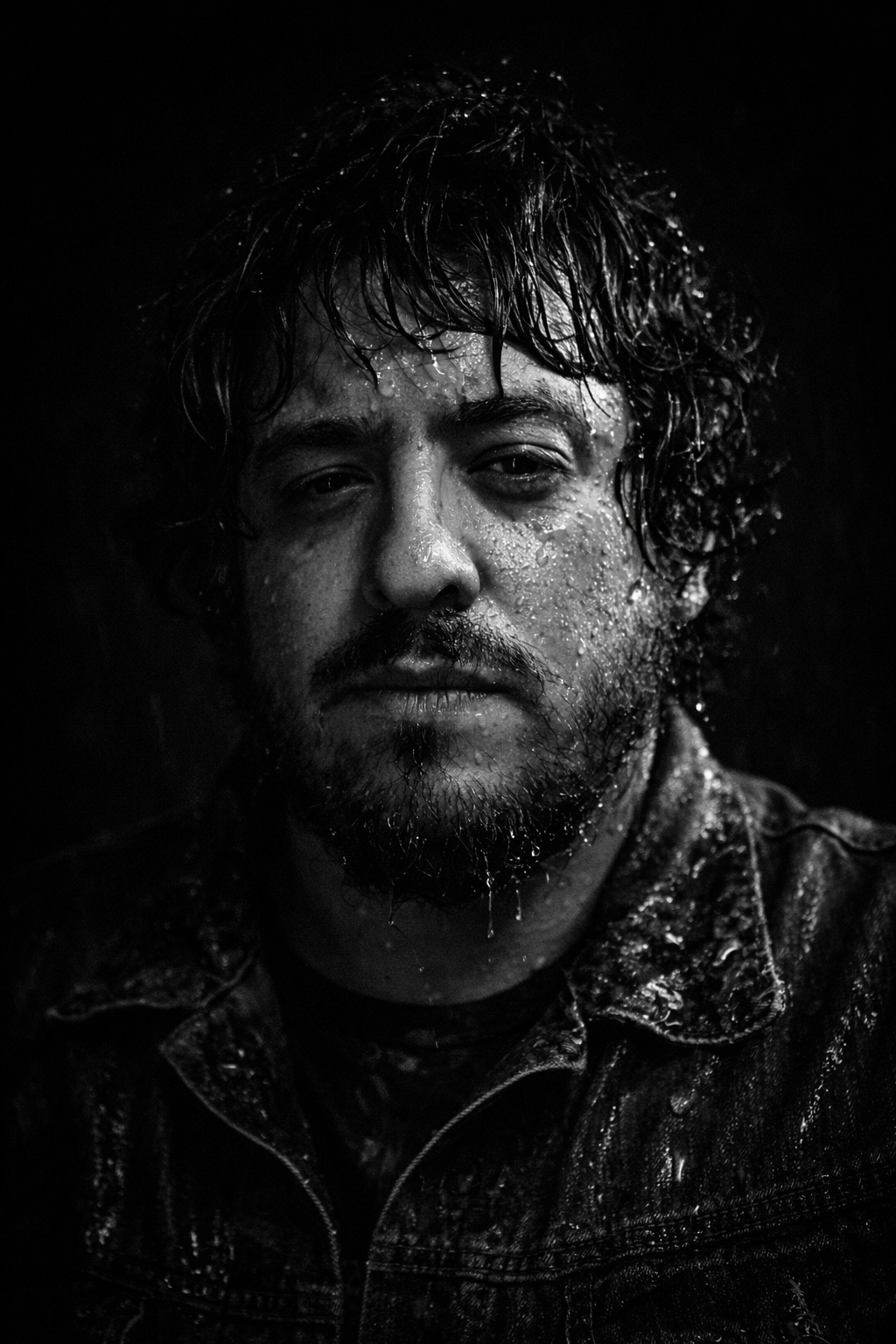
The story of Guns did not emerge from a clearly defined plan, but from a series of questions, concerns, and personal processes that gradually took shape over time. This article explores the creative path that gave rise to the novel, from its initial ideas to the construction of a distinct universe marked by war, decision-making, and moral ambiguity. Understanding this inspiration allows readers to approach Guns from a more intimate place—not only as a work of fiction, but as the result of a personal journey in which writing became a way of thinking, questioning, and understanding the world. From here, the text invites readers to accompany that journey and discover how the author’s experience intertwines with the story being told.
“The only thing that is real is death, and my desire is to give it a name.”
The influences behind Guns are diverse and engage in dialogue with one another across different narrative languages. On the literary front, Stephen King—the author’s favorite writer—stands out for his ability to combine horror, humanity, and psychological tension, a mark clearly visible in the way Guns approaches fear and inner conflict. Added to this is the depth of Latin American literature, with echoes of Juan Rulfo and Ernesto Sábato, as well as the inescapable sense of destiny present in the work of Gabriel García Márquez. Anime and manga also play a central role: titles such as Cowboy Bebop, Trigun, Akira, Vampire Hunter D by Yoshitaka Amano, Gantz by Hiroya Oku, and—inevitably—Berserk by Kentaro Miura contribute stylized action, existentialism, complex worlds, and a narrative rawness that runs throughout the work. Finally, science fiction, horror, and action cinema—with influences such as Quentin Tarantino, Guillermo del Toro, Ridley Scott, the Coen brothers, and films like The League of Extraordinary Gentlemen—shapes the visual construction, atmosphere, and morally ambiguous characters of Guns. All of these references converge not as isolated homages, but as a shared language—one that seeks to balance intensity, reflection, and a deeply human perspective.
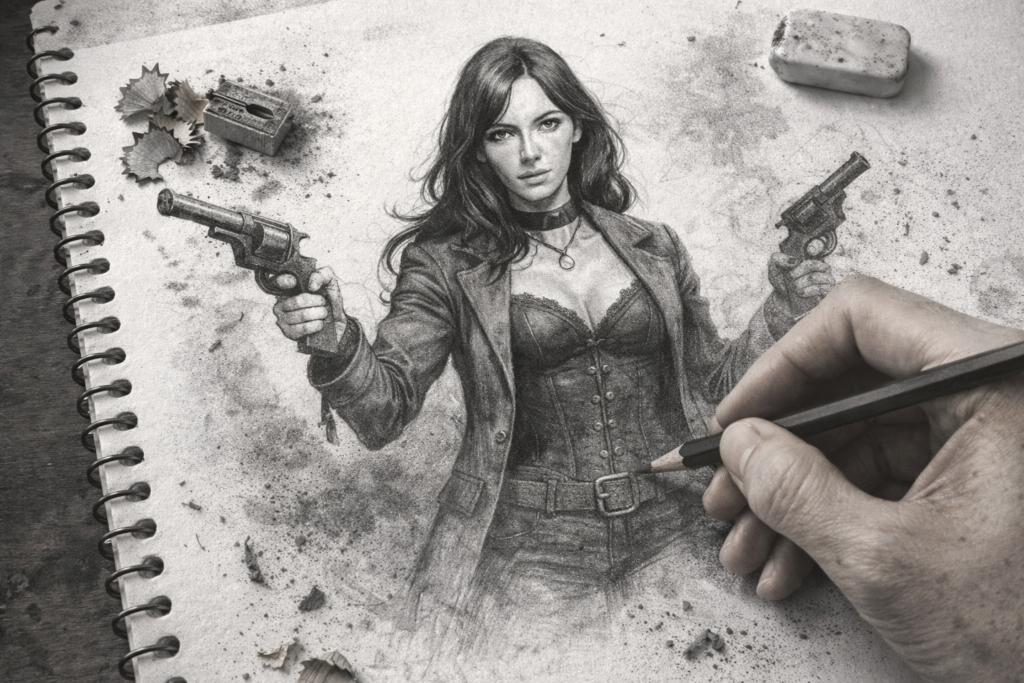
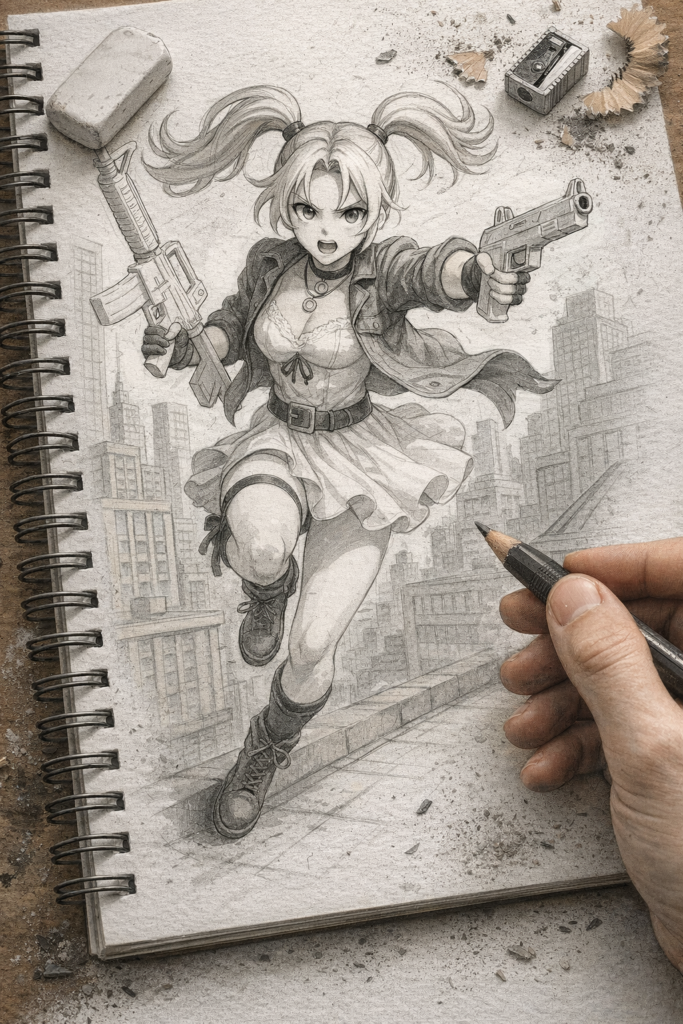
All of these influences engage directly with the author’s own experiences and inner world. In his creative process, the writing of Guns does not emerge from improvisation, but from a constant exercise in mental construction. Each night, before falling asleep, he tries to shape the story in his mind, narrating it as if it were a film—scenes, dialogue, silence, and rhythm. This is not a method he assumes to be universal among writers, but for him it is indispensable; if the story does not first flow within that mental space, he cannot transfer it to the page. In this way, Guns was rehearsed countless times before ever reaching paper. Literary and cinematic influences function as a learned language, but it is his own questions, thoughts, and experiences that ultimately articulate the narrative. It is at this intersection of lived experience, imagination, and observation that the work finds coherence and its own voice.
Final Key Ideas
Ultimately, Guns emerges from the intersection of narrative influences, cinema, literature, and a deeply personal process of reflection and internal construction. Far from improvisation, the work takes shape through ideas that are thought through, rehearsed, and mentally traversed before being written, where each scene first exists as image, rhythm, and emotion. This method not only gives coherence to the Guns universe, but also reflects a way of understanding creation as a constant dialogue between lived experience, imagination, and learning. Rather than offering closed answers, the creative journey behind the novel invites us to pause, observe, and question our own processes: how ideas are born, which paths we follow, and why certain stories need to be told. It is within this exercise of introspection and persistence that Guns finds its identity and opens the door for others to approach it—not only as readers, but as participants in an ever-expanding universe.


Leave a Reply